
Capable and Able
An etymology ramble with digressions on a French language barrier, Saints Augustine and Thomas Aquinas, and possums and armadillo.
The other day my friend Kevin Powell wondered aloud about the synonyms able and capable. What, he asked, does that prefix cap- signify in capable. He suggested that I write a Tuesday letter about it. It’s possible that Kevin was joking about there being a cap- prefix; he might also have been joking about my writing a Tuesday letter about it. But it ended up being a pretty interesting rabbit hole.
Able: Having a Handle
The word able derives from the Latin habilem, habilis, meaning “easily handled” (per etymonline.com). Habilis in turn derives from the verb habere, “to hold.” In English, when someone is able to do something, we often say they can handle it, or that they have a handle on it, or, less frequently, that they have it in hand. All these ideas are related to the Latin habilis.
Like so many Latinate words, able came to us via French. On the way over the English Channel, the ‘h’ got dropped. French people aren’t known for their ability to make the ‘h’ sound convincingly, something my daughter Margaret found out the hard way when she went to Normandy, France as an exchange student.
«Begin digression»
Margaret stayed with a family whose father was a huge history buff. Between William the Conqueror, the Bayeux Tapestry, and D-Day, who could blame him for being proud and interested in his local history?
His English wasn’t good, but he made up for it in volume and long-windedness.
At supper one night, he wanted to talk about Bell Ah-BOOR. Margaret told him she didn’t know anything about Bell Ah-BOOR. The Frenchman was shocked and distressed. They went back and forth, at cross purposes. The French history buff made hand motions and airplane noises and sounds of explosions, attempting to make Margaret understand, but she still couldn’t figure out what Bell Ah-BOOR might be.
“Sacre bleu!” the Frenchman exclaimed, adjusting his black beret* and beginning to despair of the American education system. “Ow does ze étudiante américaine not know of Bell Ah-BOOR? It is ze day that shall live en infamie!”
“Oh, Pearl Harbor,” said Margaret. “Sure, I know about Pearl Harbor.”
*Wardrobe and dialogue may have been lightly fictionalized.
«End digression»
Capable: Having Capacity
If the word able is about having a handle on something, the word capable is about having a capacity for something. The Latin capax means “capacity,” or “the ability to receive.” The phrase capax omnium, for instance, speaks of the human mind’s capacity to know everything…not that any one person could know everything, but that everything in the universe is intelligible to the human mind.
«Begin digression»
Thomas Aquinas uses the term capax omnium in relation to the idea that
everything in the universe existed as an idea in the mind of God before it existed as a thing;
therefore, everything in the universe is mind-shaped;
the human mind is made in the image of God’s mind;
therefore everything is intelligible, in theory if not in practice.
On a not-directly-related note, Saint Augustine used the phrase capax dei to express the idea that the human soul has the capacity to receive God, and furthermore, that the human soul feels empty until it is filled with God. The capax dei is related to that famous formulation, “You have made us for yourself, O Lord, and our hearts are restless until they find their rest in you.”
«End digression»
The suffix -able
As you can see in the word capable, the word able became the suffix -able. So Kevin’s possibly facetious remark had it backwards: capable is not the root able with the prefix cap-, but the root cap with the suffix -able.
A couple of interesting things about the -able suffix: first, it is usually passive. Readable handwriting is not able to read; it is able to be read. A laughable person is not able to laugh, but able to be laughed at. Something wearable is able to be worn (interesting that it isn’t “wornable” now that I think of it). In a few cases, however, including capable, the suffix -able means something along the lines of “possessing.” A capable person possesses capacity. A reasonable person possesses reason. A knowledgeable person possesses knowledge.
A second interesting and unusual thing about the -able suffix is that, even though it is Latinate in origin, it is frequently stuck onto Germanic (Anglo-Saxon) root words, as in laughable, readable, and wearable. Normally, Latinate suffixes are used only with Latinate roots. We have cognition but not thoughtion, tension but not tightion. We don’t speak of strongity.
Posse-derived Words: Having Power
In Latin, the most common way to express ability is the verb posse. It operates much like the helping verb can in English, usually used before another verb—possum videre = “I can see,” potis currere = “you can run.” Posse actually a contraction of potis (“master”—think potentate) + esse (“to be”). The idea is that to be able to do something is to have the power to do it. You can see the connection here between ability and mastery.
The words possibility and potential both derive from the posse constellation. When a young person has ability, we say they have potential, that their possibilities are endless. And here’s something else I find fascinating: to say that a thing is possible is to say that it might happen. The Germanic word might, like the Latinate words potential and possibility, is a power word. A thing that might happen (or a thing that can potentially happen) is a thing that has the power to happen.
«Begin digression»
The first-person-present conjugation of posse is possum. I am especially delighted that possum is also the name of one of the least prepossessing mammals you are likely to encounter. The possum is ugly, slow, and soft; when in danger its best defense is to grin and play dead. And yet its name is “I am able.” The similarity between the Latin word possum and the English word possum is purely coincidental and not etymological. Still, I like to think of the possum like the Little Engine That Could, always saying to itself, “I think I can, I think I can, I think I can” while it tries to get across the road ahead of the speeding car.
Having called possums unprepossessing, I should also mention a few things that make possums special:
The possum is North America’s only native marsupial.
The possum is the only North American animal with a fully prehensile tail.
The possum is one of the very few non-primates with opposable thumbs
And, in a digression to the digression, I have to pass along something I recently learned about the armadillo, facetiously known as a possum on the half-shell: the Aztec name for the armadillo, āyōtōchtli, translates to “turtle-rabbit.”
«End digression»
And finally…
My fourth novel, The Charlatan’s Boy, is being reissued by Rabbit Room Press in September with a new cover by Stephen Crotts, new illustrations by Joe Hox, and new bonus material by me. Here’s the cover:
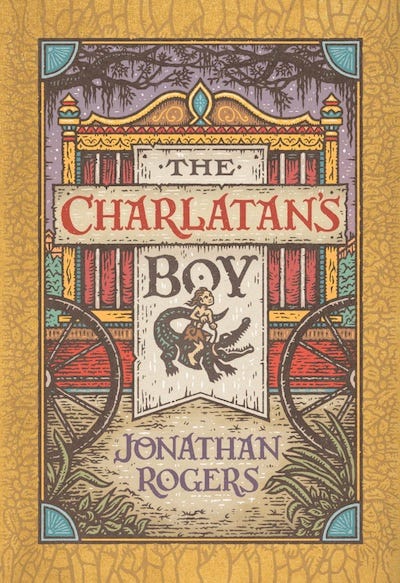
Isn’t that beautiful?

Applications are now open for the next round of Writer Development Cohorts, which will run from July 13 through August 20. Over the course of six weeks, a small group of writers will gather to do the work together. Along the way, you’ll clarify your ideas, gain confidence in your voice, and develop habits that can sustain a life of writing. If you’ve been wanting to grow as a writer but haven’t been sure what the next step might be, a Writer Development Cohort might be a good place to begin.

Virtual Writing Rooms on Monday, Tuesday, Wednesday, Thursday and Friday
This evening: Personal Essay Mini-Class, Week 3 Zoom meeting
This week in The Habit Portfolio: “This Is For You,” an essay by Elizabeth Harwell
There’s a place for you in this vibrant community of writers. Find out more about The Habit Membership here.

Angela Alaimo O’Donnell’s View from Childhood

Angela Alaimo O’Donnell is a poet, professor, and scholar whose work sits at the crossroads of faith, memory, and the literary imagination. She teaches literature and creative writing at Fordham University and serves as Associate Director of the Curran Center for American Catholic Studies.
Her latest poetry collection is The View from Childhood. She has said, “We all have a place that we come from that has helped shape us into who we are. We all have memories that stay with us, bring us joy, and haunt us, and we all face the daily decision of what to do with those memories—to preserve them or to let them fade. My vocation, as a poet, compels me to turn them into story and song. These poems tell my stories, and I also hope they, in some way, tell the reader’s.”
In this episode, Dr. O’Donnell and I talk about origin stories, Flannery O’Connor, and the idea that any writer who has survived childhood has enough material to last a lifetime.
«Begin digression» is my new favorite thing. And I can hardly wait for that bonus material!
It is! That cover is beautiful. And a story inside which is capable of capturing the hearts of lots of little people and their parents. Hooray! (And I’m leaving this piece feeling so proud of possums.)